There’s an unprecedented strain on hiring with 90% of U.S. companies missing their hiring goals and recruiters spending 38% of their time just scheduling interviews last year.
60% of organizations watched their time‑to‑hire increase in 2025, while 93% of hiring managers said the process takes longer than it did two years earlier.
What is Automated Interview Scheduling?
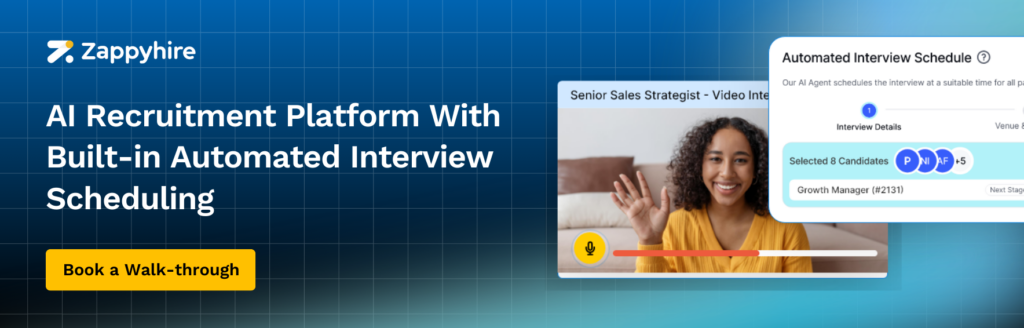
Automated interview scheduling is a system that coordinates interviews between candidates and interviewers without requiring recruiters to manually manage calendars, emails, or time slots.
Instead of going back and forth to find availability, the system integrates with calendar tools and automatically identifies suitable time slots across all participants.
Candidates can select a convenient time from available options, and the platform instantly schedules the interview, sends confirmations, and shares reminders.
Most modern automated scheduling tools also handle complex scenarios such as panel interviews, multiple interview stages, interviewer availability rules, and time-zone differences.
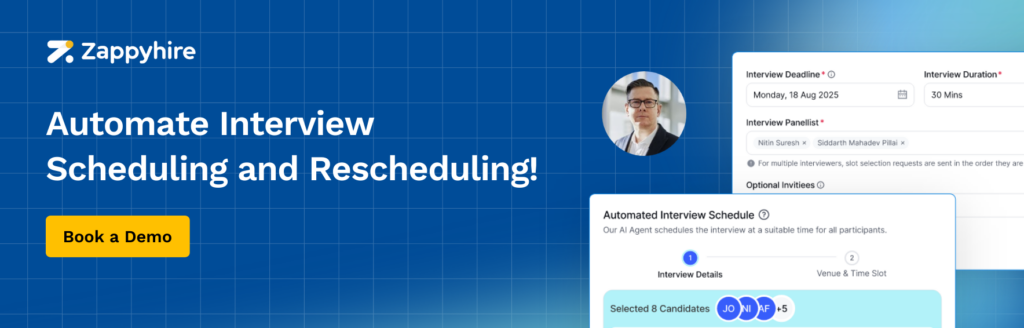
If a candidate or interviewer needs to reschedule, the system automatically adjusts calendars and notifies everyone involved.
For large organizations managing hundreds or thousands of interviews each month, automated scheduling removes one of the most repetitive administrative tasks in recruitment.
It allows recruiting teams to focus on evaluating candidates and making hiring decisions rather than coordinating calendars.
What’s The Cost of Manual Scheduling for Large Companies?
Manual scheduling looks simple on the surface – send some invites, line up calendars – but the cost to your organization is staggering.
A report found that scheduling is the single largest operational tax on hiring.
Hiring one employee takes managers 30-40 hours total, including scheduling coordination, according to SHRM data. Screening and interviewing each average 8-9 days in the process from posting to offer. This contributes to a median time-to-fill of 44 days.
Every conflict sets off a chain reaction: a forgotten calendar block, a hiring manager stuck in another meeting, or a candidate who replies late can cause the entire loop to be rebuilt.
Meanwhile, the talent market moves at warp speed. Top candidates drop off the market in ten days, yet the average time‑to‑hire hovers around 42–44 days. Slow scheduling isn’t just inconvenient as it’s shown to be quite expensive.
At scale, the issue compounds quickly. When application volume increases but processes remain manual, recruiters often shift into survival mode rather than structured evaluation.
“When the volume increases and systems aren’t in place, recruiters move into survival mode. The first degradation happens in the early-stage filtering itself.”
– Deepu Xavier, Co-Founder, Zappyhire
Each unfilled position costs $4,100 per 42‑day period and that revenue‑generating roles can cost $7k–$10k in lost earnings. The longer you take, the more it costs.
Manual scheduling also hurts the candidate experience too. Data shows that 50% of candidates have ghosted employers, and 24% blame slow communication and delays. When the process drags on, engagement drops.
Reports even show that 73% of Gen Z candidates have ghosted employers. Recruiting becomes a game of “calendar Tetris” that signals disorganization and causes your best talent to walk away.
Traditional tools break down because they assume people behave in linear, predictable ways. In reality, interviewers and candidates often change plans at the last minute, creating a domino effect of reschedules and delays. Modern teams need systems that can flex with real‑world behavior rather than force everyone into rigid patterns.
Advantages of Using an Automated Interview Scheduling Tool
Recruiters spend more than one‑third of their time scheduling interviews and coordinators spend nearly half their time juggling calendars. That’s time you could redirect to sourcing, assessing, and engaging candidates.
1. Accelerated Time‑to‑Hire
“The whole idea is to reduce time, effort, and energy. Whatever systems we introduce should help improve that efficiency.”
– Arvind Warrier, Lead – People & Culture, Volvo India
Recruitment automation systems integrate with hiring managers’ calendars to instantly
surface mutually available slots, propose options to candidates, and handle reschedules.
Because the tool never sleeps, it can schedule interviews as soon as a candidate responds rather than waiting for human hours.
The impact is real as a report found that 99.8% of talent acquisition teams either use or plan to use AI agents, and top‑performing teams restructured workflows around AI.
Organizations using automation like one-way video interview, reduced time‑to‑hire even as most companies saw it increase.
In a high‑volume market where the application/resumé ratio is exploding, this speed advantage makes the difference between landing top talent and losing them.
2. Improved Candidate Experience and Reduce Ghosting
Slow communication is the number‑one reason candidates ghost employers. Automated scheduling gives candidates control by letting them self‑schedule interviews at their convenience, view real‑time availability, and receive automatic reminders.
Research shows that 81% of job seekers expect the hiring process to conclude within two weeks. When your scheduling process respects their time, you reduce friction, demonstrate professionalism, and build trust.
In a webinar, Arvind Warrier, Lead – People & Culture, Volvo India made a simple but powerful point: “Even if it’s a one liner, ensure you respond.”
That mindset matters because fast, clear communication signals respect, while silence creates uncertainty. Automated scheduling helps companies stay consistent with confirmations, reminders, rescheduling links, and timely communication at scale.
Recruitment automation systems also handle different time zones, multi‑stage panels, and interviewer load balancing (complexities that can derail manual processes). They send confirmations, prompt interviewers to complete feedback, and ensure no candidate falls through the cracks
3. Optimized Resources in Leaner Times
Budgets are tight. Gartner reports that 78% of recruiting leaders face stagnant or shrinking budgets, and other research shows that companies tried to hire more with fewer people, which is why time‑to‑hire ballooned in 2025.
Automated scheduling scales without increasing headcount. It frees recruiters from administrative drudgery and allows them to focus on relationship‑building and strategic conversations, aka, the activities that humans do best.
This is especially important because large hiring teams do not just need more effort – they need better deployment of effort.
As Deepu Xavier, co-founder of Zappyhire noted during a webinar, many companies try to solve recruitment problems by pushing recruiters toward “more sourcing, more interviews, more KPIs,” when the real issue is often the system around them.
Automated scheduling reduces administrative load so recruiter effort can move toward higher-value work like stakeholder alignment, candidate engagement, and better hiring decisions.
AI tools also produce data that manual spreadsheets can’t. You see which interviewers are overloaded, where bottlenecks occur, and which stages take longest. This insight helps you allocate resources more effectively and hold managers accountable.
4. Better Fairness and Consistency
Human‑driven scheduling is prone to unconscious biases like picking convenient times that favor certain candidates or overlooking other applicants.
Structured hiring processes also reduce inconsistency across interviewers and teams. Without clear systems in place, evaluation often becomes subjective.
“In recruitment, a lot of decisions run on gut feeling. Unless we build a structured decision architecture, consistency becomes difficult.”
– Deepu Xavier, Co-Founder, Zappyhire
Automated systems schedule based on rules and availability rather than preferences, creating a level playing field. They also anonymize certain data points if needed and ensure that all candidates receive consistent communication and equal time.
5. Prepare for the Future of Work
Employees and leaders alike want automation. A survey found that 92% of workers worldwide want to offload part of their job to AI and that 78% say AI tools have already improved their workload.
Yet IBM’s Institute for Business Value reports that only 20% of executives believe HR is driving their company’s future‑of‑work strategy. But forward‑thinking HR leaders see automation as a chance to reclaim their strategic seat.
“HR is best positioned to design the future blended human-machine workforce. This is an opportunity for human resources to reinvent itself, to reimagine itself, to lead the enterprise and the workforce through the single biggest work redesign since the Industrial Revolution.”
– Greg Vert, AI leader at Deloitte Consulting
While Greg Vert believes HR is uniquely positioned to design the blended human‑machine workforce, SAP’s Dan Beck warns that CEOs and boards are asking CHROs, not CIOs, about their AI roadmaps.
“CHROs are being asked: ‘What’s your AI roadmap?’ HR leaders are expected to know not only how AI affects the HR function, but the entire employee base of the company”
– Dan Beck, President and Chief Product Officer, SAP SuccessFactors
Analyst Anthony Abbatiello argues that CHROs must own the workforce end to end to deliver business outcomes.
“CHROs have to look at their job as owning the workforce end to end. That means playing a lead role in “agentifying” a function—figuring out how to combine human talent and imagination with agentic capabilities. Then they’ll need to “manage that workforce with both humans and AI agents—each with different skills,”
– Anthony Abbatiello, Workforce Transformation Leader, PwC US
In other words, the future of recruitment belongs to HR teams who embrace intelligent automation and use it to empower – not replace – people.
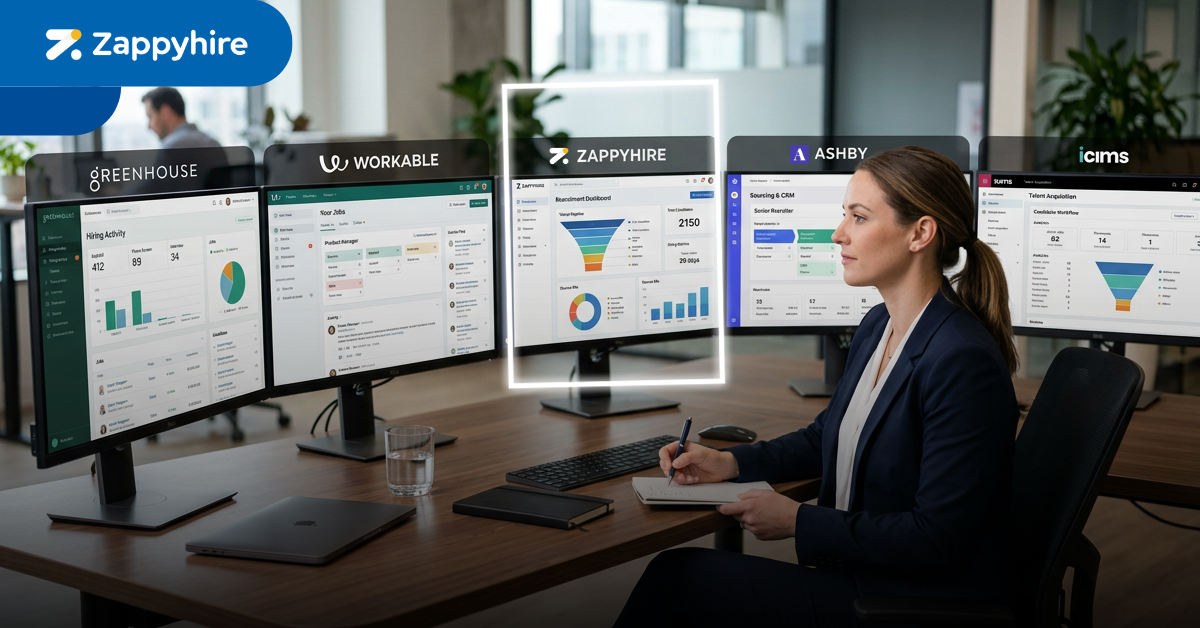
Look For a Recruitment Platform with Built-in Automated Interview Scheduling Tool
While there are plenty of standalone interview scheduling tools available, relying on them often means juggling multiple systems – like one for recruitment and another for scheduling.
This adds unnecessary complexity and increases manual effort across your hiring process. Instead, opt for a recruitment platform that has interview scheduling built in and integrates seamlessly with tools like Google Calendar and Outlook.
This way, everything, from candidate screening to interview coordination, happens in one place, making your workflow more streamlined, efficient, and easier to manage at scale.
Here are some features you can consider,
- Calendar and email integration: Seamless syncing with Google Calendar, Microsoft Outlook and other systems to pull real‑time availability and send invites automatically.
- Candidate self‑scheduling: Provide candidates with a link to pick available times on their own. Look for customizable buffers, blackout dates and the ability to propose multiple slots.
- Panel and multi‑stage scheduling: Support for complex interview loops, panel discussions and sequential interviews without manual coordination.
- Time‑zone management: Automatic detection of time zones and conversion to avoid confusion for remote candidates and global teams.
- Load balancing and interviewer skills: Ensure that the right interviewers are scheduled for each stage, avoid overloading certain people and factor in required certifications or training.
- Reschedule handling: Intelligent workflows to manage cancellations, reschedules and no‑shows with minimal disruption.
- Reminders and communication: Automated confirmations, reminders and follow‑ups for both candidates and interviewers via email or SMS.
- Analytics and insights: Dashboards that reveal bottlenecks, measure time‑to- schedule, and track interviewer participation to inform continuous improvement.
- Security and compliance: Robust data‑privacy controls, adherence to GDPR/CCPA and audit trails to ensure fairness and compliance.