For recruiting teams, particularly those tackling high‑volume hiring, every open role represents lost productivity and a future colleague waiting to contribute.
Yet the gap between posting a job and bringing someone on board keeps widening.
Industry research consistently shows average time-to-hire has climbed to 44–68 days in 2025-2026 (up from 43 days in 2023-2024), reflecting a multi-year trend of lengthening recruitment cycles driven by more interview rounds, tighter skills requirements, and cautious hiring decisions.
Long delays also cause attrition as 42% of candidates admitted they leave a hiring process when scheduling an interview takes too long, and 56% said they drop out because of frustrating scheduling experiences.
Another report found that 26% of job seekers declined offers after a poor hiring experience, while 66% accepted offers because of a positive experience.
In other words, how you hire matters as much as who you hire.
How to Hire Faster Without Compromising on Candidate Quality for Bigger Companies
Hiring faster doesn’t have to mean cutting corners. Large recruitment teams can reduce time‑to‑hire, improve candidate quality and, just as importantly, create a hiring experience that top talent appreciates.
1. Define the Process and Clarify Requirements
Hiring often fails before it begins when job requirements are vague or constantly changing. Start by building standardized job descriptions and aligning them with business needs.
Especially in bigger companies, having the right SOPs in place for your hiring is non- negotiable.
Develop competency profiles – Identify the essential skills and competencies for each role rather than focusing solely on years of experience. This approach supports skills‑based hiring.
Standardize job descriptions – A consistent template makes it easier for applicants to understand expectations and for hiring teams to compare candidates fairly.
Set realistic timelines – At the kickoff meeting, agree on when the shortlist should be ready and when interviews and offers need to be completed. High‑performing teams treat deadlines as non‑negotiable.
“I am convinced that nothing we do is more important than hiring and developing people. At the end of the day, you bet on people, not on strategies.”
– Lawrence Bossidy, Former Chairman and CEO at Honeywell International Inc.
2. Leverage AI-Driven Screening and Ranking Tools
Manually sifting through hundreds (or thousands) of résumés is one of the biggest bottlenecks during high-volume hiring phases. An agentic AI‑powered applicant tracking system (ATS) can automate résumé parsing, shortlisting and even initial communication.
This frees recruiters to focus on high‑value tasks and reduce different types of unconscious biases.
Reduce time spent on manual screening – Studies show recruiting teams now conduct
42% more interviews per hire than in 2021, which contributes to longer time‑to‑hire. Automated candidate pre-screening tools help identify top‑fit candidates earlier and cut down unnecessary interviews.
Enable data‑driven decision‑making – Modern ATS platforms can score candidates based on skills, experience and cultural fit. Customizable fields allow you to track whatever matters most to your business, enabling data‑driven comparisons rather than gut‑feel decisions.
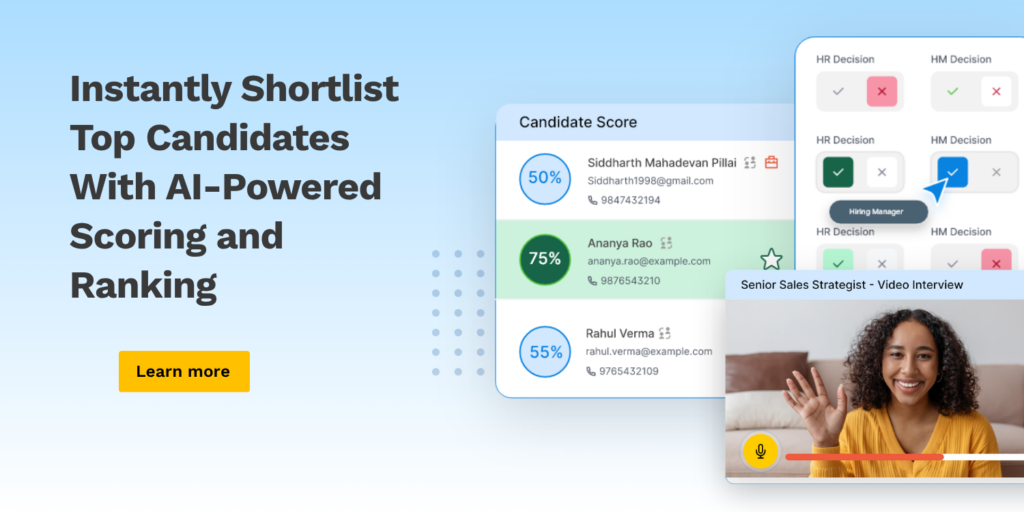
Reduce bias – Structured scoring criteria and AI‑augmented assessments ensure each applicant is evaluated against the same standards.
3. Simplify Applications and Reduce Candidate Friction
Lengthy or confusing applications drive qualified applicants away.
“9 out of ten potential applicants drop out because they encountered a frustrating application process. If [the candidate] had an unexciting interview or feels like they are being treated poorly because of a lack of feedback, or even a rude recruiter or disinterested hiring manager, the best will exit quickly. The very best candidates are being pursued by several firms, so they are likely to have one or more offers within 10 days.”
– Dr. John Sullivan, HR Thought Leader
If candidates can’t easily apply, they won’t – and your hiring speed will slow.
Shorten the form – Ask only for necessary information at the first step. You can collect additional details later in the process.
Make it mobile‑friendly – Many candidates search and apply via smartphones. Ensure your application system works seamlessly on any device.
Communicate expectations up front – A candidate experience report from CareerPlug found that nearly 47% of job seekers expect salary information before applying.
Transparent postings reduce back‑and‑forth later and build trust.
4. Automate Interview Scheduling and Embrace Asynchronous Video Interviews
Scheduling interviews is the black hole in recruiting. A report found that 42% of candidates drop out when scheduling takes too long and that 56% leave because of frustrating scheduling experiences. Automation solves this bottleneck.
“[When it comes to screening and interview scheduling], what works at 50[applicants] will break at 5000”
– Deepu Xavier, Co-founder of Zappyhire
Use automated scheduling tools – Integrated schedulers let candidates choose available times instantly. Data shows 70% of candidates view a smooth scheduling experience as a key factor in whether they accept an offer.
Offer asynchronous video interviews – According to a recruiting report, 60% of recruiters now use video technology in their hiring process, and 45% say it speeds up hiring. One‑way video interviews allow candidates to record responses on their own time, enabling recruiters to screen more candidates without scheduling conflicts.
Reserve live interviews for later stages – This combination balances efficiency with human connection, and one-way video interviews prevent bias in hiring.

5. Implement Structured Interviews and Skills-Based Assessments
Unstructured interviews are inconsistent and can prolong hiring. Hiring teams make decisions faster and with more confidence, by using structured, standardized interviews and objective assessments.
Prepare scoring rubrics – Create a rubric for each role with clear criteria and ratings. This helps interviewers focus on relevant competencies and accelerate debrief.
Conduct skills‑based tests – Using coding challenges, writing exercises or job simulations reveals true capability and reduces reliance on lengthy panel interviews.
6. Build and Nurture Talent Pipelines
High‑volume hiring rarely starts from zero. Cultivating pipelines of engaged candidates – whether from past applicants, alumni, or passive talent – shortens time‑to‑hire when new requisitions open.
“It doesn’t make sense to hire smart people and then tell them what to do; we hire smart people so they can tell us what to do.”
– Steve Jobs, Former CEO of Apple
A strong talent pipeline ensures you consistently have access to those smart people,
before you actually need to hire them.
Use candidate relationship management (CRM) tools – Maintain a centralized database of candidates and segment them by skills, experience and interest. This will help you track interactions and build relationships over time.
Engage regularly with your talent community – Share company updates, invite prospects to virtual events and provide value (e.g., industry insights). This keeps your employer brand top of mind.
Leverage referrals – People trust people they know. Referrals often lead to faster hires and higher retention.
7. Align Recruiters and Hiring Managers on Speed and Quality
One of the most common sources of delay is misalignment between recruiting teams and hiring managers. Different expectations on candidate profiles, interview schedules and decision timelines lead to endless back‑and‑forth.
Kickoff meetings with clear deliverables – Collaborate at the start to define must-have versus nice-to-have criteria, interview panels and decision-makers.
Set SLAs (service-level agreements) – Agree on how quickly résumés will be reviewed, interviews will be completed and feedback will be given. Strengthening recruiter-hiring-manager relationships improves quality of hire and reduces time-to-hire.
Provide data to drive urgency – Share time-to-hire metrics, candidate drop-off rates and market salary benchmarks to underscore the cost of delays.
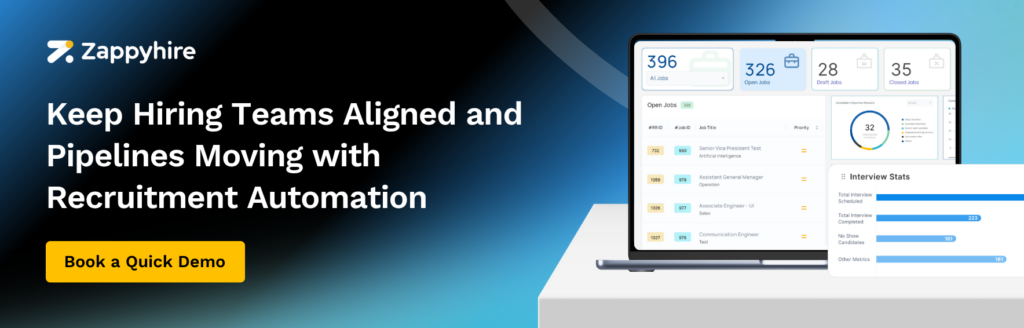
Leverage recruitment automation and collaborative hiring – Use automation to standardize screening, scheduling and follow-ups so dependencies don’t slow things down. Collaborative hiring platforms ensure feedback is captured in one place, decisions aren’t delayed due to missing inputs and everyone stays aligned in real time.
“Most hiring delays don’t come from lack of candidates – they come from process gaps and coordination breakdowns. When feedback loops are slow and decisions aren’t centralized, even the best candidates slip through.”
– Jyothis KS, Co-founder at Zappyhire
8. Prioritize Candidate Experience
Candidates who feel valued and respected move through the process faster and are more likely to accept offers. A report found that 66% of candidates accepted a job because of positive hiring experience and 26% declined offers due to poor experiences. Also, 36% of candidates rejected offers after a negative interview.
Communicate consistently – Provide timely updates and feedback, even to candidates who aren’t moving forward.
Treat candidates like customers – Make interviews a two‑way conversation. Offer resources about your culture and team. Even candidates who aren’t selected can become brand advocates if treated well; Executive Search consultant Eva Toledo notes that positive experiences can lead to referrals from candidates who weren’t hired.
“We have even seen referrals from candidates who were not selected based on the positive experience they had with us.”
– Eva Toledo, Executive Search consultant at Kepler Search
A positive candidate experience is also a competitive advantage. In a tight labor market, job seekers often juggle multiple offers. When your process is efficient and respectful, you become the employer of choice.
9. Embrace Continuous Improvement Through Analytics
Finally, hiring faster is not a one‑time initiative but an ongoing discipline. Use analytics to identify bottlenecks and track progress.
Monitor key metrics – Track time‑to‑hire, time‑to‑fill, source of hire, pass‑through rates, interview‑to‑offer ratios and candidate satisfaction scores.
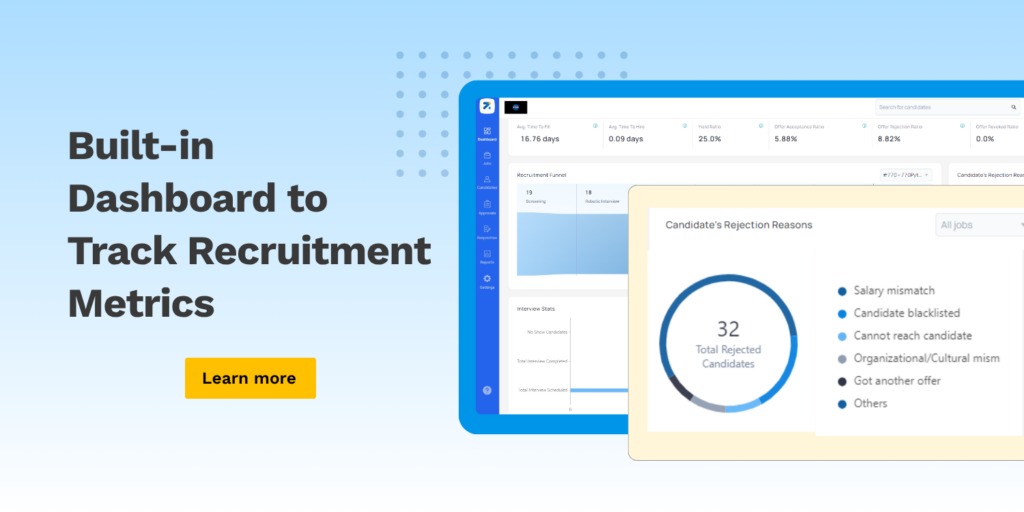
Benchmark against industry data – Compare your performance to industry averages, and set goals to outperform the benchmark.
Experiment and iterate – Use data to test new strategies – such as automated assessments, recruitment chatbots or self‑scheduling – and analyze the impact on speed and quality.
Hire Faster Without Compromise
Hiring faster doesn’t mean your team should rush through it. Hiring faster is removing friction, focusing on what matters, and empowering your team through smart technology.
With the right strategies and tools, you can hire faster without compromising on quality or candidate experience.
FAQs
1. Why is time-to-hire increasing in recent years?
Time-to-hire has increased due to more interview rounds, stricter skill requirements, and cautious hiring decisions. Additionally, manual processes and poor coordination between teams contribute to delays.
2. Does hiring faster affect the quality of hire?
No, hiring faster does not mean compromising quality. When done correctly – using structured interviews, AI-driven screening, and skills-based assessments – it can actually improve quality by focusing on relevant competencies.
3. What role does AI play in hiring faster?
AI helps automate resume screening, candidate ranking, and communication. It enables recruiters to identify top candidates quickly, reduce bias, and make data-driven decisions instead of relying on manual processes.
4. How do automated video interviews speed up hiring?
Automated (one-way) video interviews allow candidates to record responses at their convenience. Recruiters can review them anytime, eliminating scheduling delays and enabling faster shortlisting of candidates.
5. Why is candidate experience important for faster hiring?
A positive candidate experience reduces drop-offs and increases offer acceptance rates. Candidates are more likely to stay engaged and move quickly through the hiring process when communication is clear and timely.
6. What are the biggest bottlenecks in hiring speed?
Common bottlenecks include:
- Manual resume screening
- Interview scheduling delays
- Misalignment between recruiters and hiring managers
- Lengthy application processes
- Lack of structured interviews
Addressing these can significantly improve hiring speed.