Candidate shortlisting has always been the biggest (or should we say narrowest) bottleneck in hiring, hasn’t it?
Recruiters who handle high-volume hiring are overwhelmed by resumes, yet they need to move quickly to land top talent. And when candidate shortlisting is mostly manual, it’s slow, biased and exhausting.
A report notes that the average corporate job opening attracts 250 resumes. And according to multiple studies, recruiters spend 6–8 seconds scanning each resume, and only 2% of applicants get an interview.
With that many applications and so little time, great candidates often slip through the cracks.
So, let’s explore why manual shortlisting holds your team back and how automation changes your process for the better.
Five Reasons to Automate Candidate Shortlisting
1. Interviews Happen Faster
Speed is everything in recruitment. Top candidates go off the market quickly, often within ten days. When recruiters rely on manual screening, it can take days just to whittle down the applicant pool.
59% of companies already plan to increase investment in recruitment AI, and it’s clear why.
“AI will become a core enabler in recruitment – automating processes while enabling smarter decision-making.”
– Rachit Chandra, Director APAC Talent Acquisition Head, Cloudera
With automation, resumes are processed in minutes and qualified candidates can be contacted the same day.
2. Dramatic Reduction in Manual Work
Manual screening consumes a huge portion of recruiters’ schedules. Teams can reclaim hours each week by automating the first pass.
In Zappyhire’s Recruitment Trends 2026 study, 68% of organizations report improved recruitment efficiency due to AI, making efficiency the top benefit of AI adoption.
“Recruiters will focus more on strategic engagement, while AI handles repetitive tasks.”
– Mayuresh Samant, Senior Manager Talent Acquisition, Shaadi.com
Recruiters no longer need to memorize complex Boolean searches or scroll through endless resumes. Instead, they can focus on candidate experience, employer branding and advising hiring managers.
For example, India’s leading automobile manufacturer reports handling hiring at scale with over 1,00,000 candidates screened and 26,000+ hires deployed within a year, all while running 100+ recruitment drives using Zappyhire.
3. Higher‑quality Shortlists
Beyond speed, automation in large scale recruitment also improves outcomes, as a leading bank with over 10,000 employees, 1,500+ branches, 2,000+ ATMs/CDMs report a 72% increase in quality of hirealongside faster hiring cycles.
AI doesn’t get tired or overlook details. It evaluates every applicant against consistent, predefined criteria. This leads to more accurate shortlists and fewer false negatives.
Standardized evaluation reduces the impact of unconscious bias and ensures that overlooked talent gets a fair chance. Over time, the system learns from your hiring decisions and improves its recommendations.
4. Better Candidate Experience
Candidates hate waiting. Slow response times and lack of feedback damage your employer branding. When candidate shortlisting is automated, applications are acknowledged instantly, and qualified candidates move forward without delay.
According to a study by Zappyhire, almost 70% using AI for recruiting cite saving time and increasing efficiency as a primary reason. Faster processes translate to a better candidate experience and higher acceptance rates.
5. Reduced Bias and Improved Diversity
Automation removes many subjective elements from the screening process. AI evaluates candidates based on skills and qualifications, not their names or backgrounds.
How to Automate Candidate Shortlisting
No recruiter enjoys digging through hundreds of resumes hoping to find a few good fits. So, here’s how hiring teams are making candidate shortlisting faster, lighter, and a lot more effective by build a process that works for them.
1. Get Clear on What “Good” Looks Like
Before anything else, define your ideal candidate. What skills are non-negotiable? What experience really matters?
Modern recruitment automation platforms make this easier with structured criteria and custom fields so your system knows exactly what to look for, not just what to scan. Instead of vague job descriptions, you’re translating hiring expectations into measurable inputs.
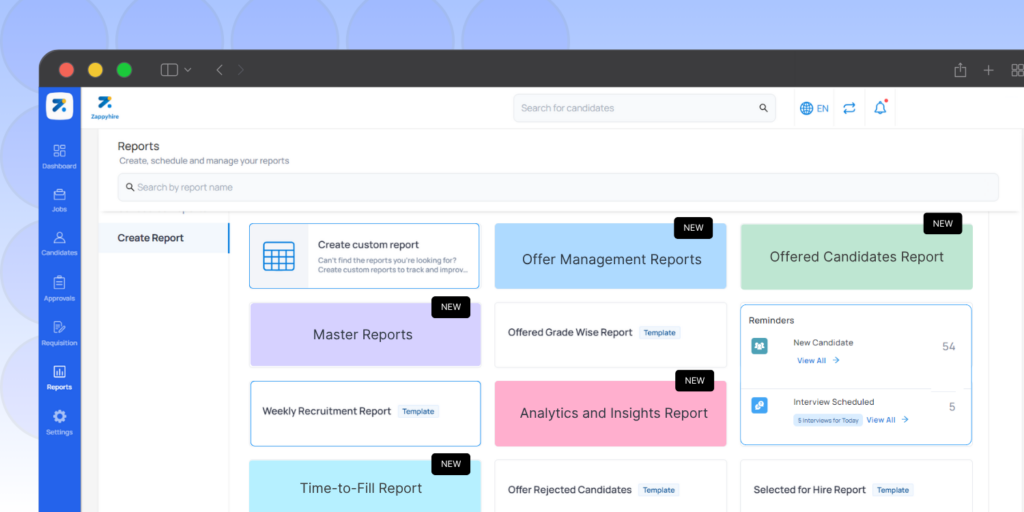
This matters more than it seems. Research shows that inconsistent evaluation criteria is one of the top reasons for poor hiring decisions and delays. When every recruiter or hiring manager interprets “good” differently, shortlisting becomes subjective and slow.
Structured criteria fixes that. You can define:
- Must-have vs good-to-have skills
- Role-specific competencies
- Experience thresholds
- Evaluation parameters across teams
Everything becomes standardized, searchable, and comparable.
Once this foundation is in place, automation actually works as intended by filtering candidates based on relevance.
2. Let AI Take Over Resume Screening
Instead of scanning every CV manually, AI-powered semantic resume parsers can instantly read and organize candidate data – skills, experience, qualifications, all of it.
So instead of searching, you’re simply reviewing what already makes sense.
3. Automatically Filter the Right Candidates
For example, a small finance bank operating 718 ATMs and 1,110 service centers across 24 states, serving 9M+ customers with an 11K+ workforce, deals with hiring at serious scale.
At this level, manual screening doesn’t hold up. With smarter filtering in place, this company achieved up to 5X fewer candidate drop-offs and 2X better hiring quality by moving only the right candidates through the funnel.
Set up simple rules like:
- Must-have skills
- Minimum experience
- Role-specific requirements
And let the system handle the first round of elimination. There won’t be any more scrolling through irrelevant profiles just to find a handful that fit.
4. Screen Smarter by Going Beyond Resumes
Recruiters spend up to 23 hours per hire just screening resumes, but a resume only tells part of the story. In high-pressure environments like healthcare hiring, introducing structured pre- screening has reduced recruitment time by up to 60%, helping teams fill roles faster without compromising quality.
Many teams now add a quick pre-screening layer using asynchronous video interviews – where candidates respond to a set of questions on their own time. Tools like ZappyVue make this seamless to run at scale.
This way, by the time someone reaches your shortlist, you’ve already seen how they think, communicate, and respond.
5. See Your Best Candidates First
Instead of a pile of applications, imagine a ranked list of your top candidates.
AI-based scoring helps prioritize candidates based on how well they match your criteria – factoring in skills, experience, and contextual relevance – so you can act fast without second- guessing every decision.
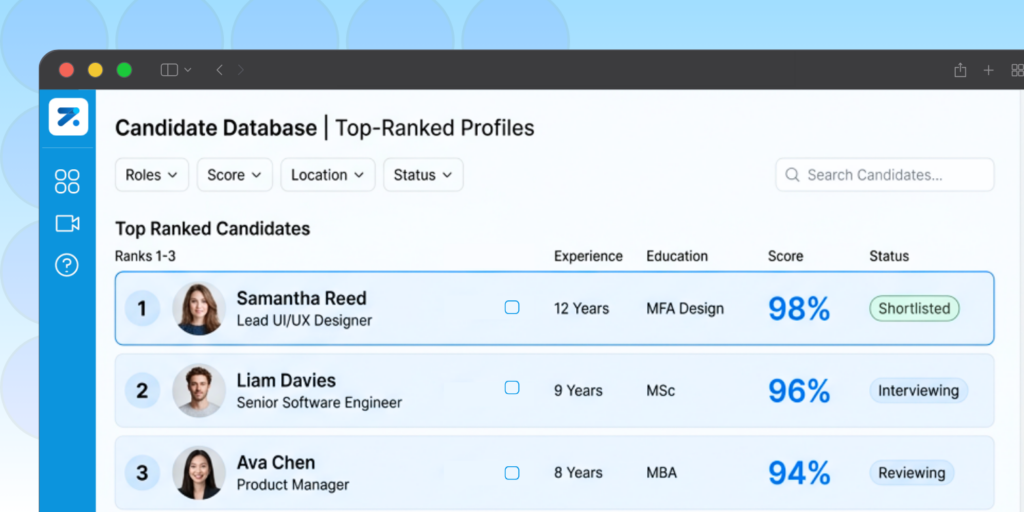
This isn’t just convenience as it directly impacts hiring speed and quality. Recruiters spend majority of their hiring time on initial screening, and without prioritization, high-potential candidates often get reviewed too late.
With AI-driven scoring:
- Every candidate is evaluated consistently
- Top matches surface instantly
- Recruiters focus only on high-fit profiles
Instead of asking “Who should I look at first?”, the system answers it for you.
And when your best candidates are identified early, outreach happens faster, which is critical when top talent is off the market in days.
6. Keep Candidates in the Loop (Without Extra Effort)
Nobody likes applying and hearing nothing back. Automate simple touchpoints like:
- Application acknowledgements
- Interview invites
- Status updates
Most modern ATS platforms, including Zappyhire, handle this quietly in the background, keeping candidates engaged without adding to your workload.
At the end of the day, these will remove the parts of the job that slows you down.
FAQs
What is candidate shortlisting?
Candidate shortlisting is the process of identifying the most suitable applicants from a candidate pool based on predefined criteria such as skills, experience and qualifications.
How does automation improve candidate shortlisting?
Automation applies AI to parse resumes, match skills to job requirements, score candidates and generate a shortlist. It speeds up the process, reduces manual effort and improves consistency. Recruiters then review only the most relevant applicants.
Does automated shortlisting replace recruiters?
No. Automation handles repetitive tasks, allowing recruiters to concentrate on higher‑value work like engaging candidates, building relationships and making strategic decisions. Human judgment and empathy remain essential.
Can automation reduce hiring bias?
Yes, when designed responsibly. AI evaluates candidates based on objective data and consistent criteria, mitigating unconscious bias and about one‑third of organizations using AI for recruiting reported improved diversity in hiring.