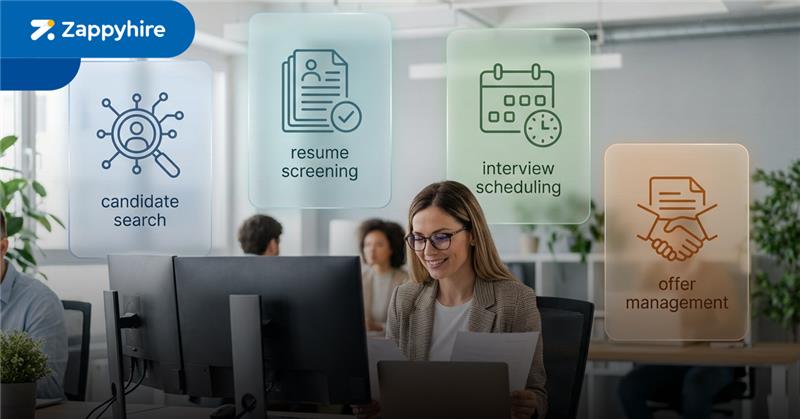
Traditional hiring was built for a role-based hiring world of defined job titles, fixed requirements, and linear hiring workflows.
That model no longer holds up. As roles evolve faster than job descriptions and skills become more transferable across functions, organizations are rethinking how they identify and evaluate talent.
This move toward skills-based hiring has exposed the limitations of traditional recruitment processes, especially at enterprise scale. Manually assessing skills, ensuring consistency across interviews, and maintaining speed across high volumes is difficult without the right systems in place.
“We are moving from role-based hiring to skills-based hiring—and AI is the backbone of that shift.”
Yogendra Soobarah, Chief People & Culture Officer, Pan-African Bank
AI-powered recruitment platforms step in here by enabling scalable assessments, structured evaluations, and integrated hiring workflows from sourcing through onboarding.
In this guide, we’ll share practical examples of AI in recruitment across each stage from sourcing to onboarding.
AI in Recruitment Examples: How Companies Use AI Across the Hiring Funnel
Step 1: Sourcing & Job Advertising
AI streamlines sourcing by finding and prioritizing the right candidates faster, improving job visibility, and reducing drop-offs during the first touchpoints.
Here are a few AI in recruitment examples you’ll commonly see at this stage.
Candidate sourcing – AI sourcing helps recruiters discover and shortlist people who are likely to fit across your ATS database, past applicants, referrals, and external profiles. Instead of keyword-only searches, many tools use smarter matching to surface relevant talent and rank them for review.
Put your jobs in the right places automatically – For job advertising, AI is commonly used in programmatic recruitment advertising – meaning it can automatically distribute jobs across multiple channels and optimize spend based on performance, so you’re not manually guessing where to post or wasting budget on low-quality sources.
Make the job application process easy (and reduce drop-offs) – AI assistants or AI-powered recruitment chatbots on career pages (and chat channels) can handle FAQs, guide candidates through steps, and capture basic details, so candidates don’t abandon the process when nobody replies.
Step 2: Resume Screening & Candidate Management
Sorting through thousands of applications is where most teams lose time. This stage is about quickly filtering who qualifies through candidate prescreening, keeping your database clean, and making sure nothing slips through the cracks.
These are some of the most widely used examples of AI in recruitment for handling application volume.
AI-based résumé parsing and eligibility checks – NLP models extract structured data from résumés and compare it against predefined role criteria (experience, skills, location, notice period). Candidates are automatically classified as eligible or ineligible based on rule-based logic combined with AI-driven text interpretation.
“For a single role in a large organization, you can easily get hundreds or even thousands of applications. When you receive 500 applications, all you can realistically do is filter and talk to the top 10 or 20 and hope you find five good candidates. You can’t realistically talk to 500 applicants to assess language, skills, cultural fit, and how they present themselves.”
Deepu Xavier, Co-founder, Zappyhire & ZappyVue
Some platforms go a step further by using AI to recommend candidates across both new and existing roles.

For example, Shaadi. com faced data inconsistencies when multiple ATS platforms could not sync reliably with its career page. By integrating Zappyhire, applications were centralized and validated automatically using AI, improving data integrity and candidate experience!
Duplicate detection using identity matching – AI models detect duplicate profiles by analyzing name variations, contact details, work history patterns, and résumé similarity, preventing repeated reviews of the same candidate across sources.
Data normalization across channels – AI helps standardize candidate data coming from career pages, job boards, and referrals, ensuring consistent status tracking and reducing errors caused by mismatched or incomplete records.
Step 3: Assessments & Pre‑Qualification
AI assessments evaluate candidates’ skills beyond resumes, cognitive abilities and even behavioral traits. They help recruiters move beyond résumés to identify high‑potential talent.
AI-scored assessments – Assessment engines use predefined scoring logic and AI-assisted evaluation to analyze technical, domain, or role-specific tests. This enables faster shortlisting based on objective performance metrics rather than manual interpretation.
AI-assisted video screening – Automated video interviews use AI to structure questions, analyze responses, and surface signals such as content relevance, communication clarity, and completion consistency, helping recruiters identify suitable candidates early in the funnel.
“The fastest ROI came when we used AI to solve for both velocity and volume—without compromising quality. Early AI adoption in screening and scheduling helped us reduce turnaround time by more than 60%”
Payal Nambiar, Senior HR Leader, Ex-Samsung
In practice, AI-led video interviews are most effective when they reduce review effort rather than replace judgment.

Platforms like Zappyhire combine structured video interviews with AI-generated candidate summaries, giving recruiters a concise overview of responses, key signals, and completion quality, so they can review more candidates without increasing evaluation time.
Conversational AI for pre-qualification – AI-driven Q&A flows validate non-negotiables (availability, salary range, shift, location) through conversational interfaces, ensuring only aligned candidates move forward, especially useful in high-volume hiring.
Step 4: Interview Scheduling & Communication
Once candidates are shortlisted, the bottleneck becomes coordination. Here, AI reduces coordination friction by predicting availability, automating decisions, and maintaining engagement.
“At every stage of the hiring funnel, communication quality matters – poor updates damage candidate experience even when rejection is inevitable.”
Manish Pandey, VP – Human Resources, South India, Maruti Suzuki
AI-based scheduling recommendations – Scheduling systems use rules and availability data to suggest optimal interview slots, minimizing back-and-forth while learning from past scheduling behavior.
AI-triggered candidate communication – AI determines when and how to send reminders, updates, or nudges based on candidate behavior patterns (missed actions, delays), reducing no-shows and drop-offs.
Unified tracking powered by workflow intelligence – AI-enabled platforms maintain a real-time view of candidate progress, identifying stalled stages and prompting action automatically.
Step 5: Decision‑Making & Offer Management
This is where teams need clarity and speed without losing consistency. The goal is evidence-based shortlisting and smoother offers.
AI-supported hiring insights – Recruiters and hiring managers see consolidated performance data across stages (assessments, interviews, and evaluations) allowing AI-assisted comparisons that reduce subjectivity and improve decision consistency across teams and locations.
“Real AI impact shows up when conversion improves across stages and lead times reduce between each step—not just in overall time-to-hire. Bias reduction, quality of hire, speed, and candidate experience—these are the measurable outcomes that matter when deploying AI.”
Manish Pandey, VP – Human Resources, South India, Maruti Suzuki
To support final shortlisting, some systems use AI-driven candidate ranking to compare applicant profiles against job requirements, assessment outcomes, and interview data.
In tools like Zappyhire, this comparison helps teams prioritize candidates quickly, fairly and consistently, which is especially useful when multiple recruiters or hiring managers are involved across locations.
For example, Federal Bank reported a 72% improvement in hiring quality, while its time to fill positions fell by 65%.
Offer letter automation with rule-based intelligence – AI-enabled systems generate offers using predefined compensation logic, role rules, and approval workflows, reducing errors while accelerating turnaround time.
Step 6: Onboarding & Integration
Post-offer, AI focuses on preventing joining drop-offs and ensuring smooth handoffs.
AI-triggered onboarding workflows – Once an offer is accepted, AI-driven workflows automatically initiate document collection, approvals, background checks, and system handovers based on role and location logic.
Integrations help push candidate data into HRMS/payroll/BGV tools so teams don’t duplicate effort or end up with mismatched records.
“AI systems must talk to each other—without a unified data fabric, intelligence stays siloed.”
Deepu Xavier, Co-founder, Zappyhire & ZappyVue
Agentic AI for follow-ups and escalation – Agentic AI can independently handle actions such as sending reminders for pending documents, nudging approvers, answering onboarding FAQs, escalating delays, and updating statuses without recruiter intervention.
Predictive analytics for post-offer visibility – AI-powered dashboards analyze offer-to-join trends, onboarding delays, and drop-off reasons, helping teams identify patterns across roles, locations, or approvers and fix bottlenecks proactively.
Why AI Adoption in Recruitment is Accelerating
AI adoption in recruitment is accelerating for a simple reason – hiring pressure is rising faster than recruiter bandwidth, and teams can’t keep scaling manual workflows without breaking something.
What’s interesting is that interest in AI is already mainstream, but real usage is still catching up.
In fact, even though 78.3% of organizations say they’ve adopted AI in recruitment, that number drops when adoption is defined as active use: only 47.8% are using AI beyond pilots, while 52.2% are either still exploring or haven’t started at all.
The ones that crack integration – data flows, workflow design, recruiter trust, and governance – pull ahead fast because the impact compounds across the funnel (screening speed, consistency, visibility, and cost per hire).
A good example is Maruti Suzuki, which used Zappyhire’s AI-powered recruitment system to achieve scale within a year: 1,00,000+ candidates screened, 26,000+ deployed, 100+ recruitment drives, and 100+ onboarded every day – run across 31 hubs in 12 states with a fully digital, end-to-end recruitment process and real-time visibility that directly improved time-to-hire.
Final Thoughts & Best Practices
AI in recruitment, when thoughtfully deployed, enhances every step of the recruitment lifecycle. If you’re collecting examples of AI in recruitment to build an internal business case, map each use case to a bottleneck (time, cost, quality, or candidate experience). To maximize results:
- Identify your biggest bottlenecks. Whether it’s sourcing, screening or scheduling, start with the pain point that consumes the most time.
- Choose ethical and configurable tools. Look for platforms with transparency, bias‑mitigation features and customization options. (Zappyhire offers high configurability and responsive client support.)
- Maintain human oversight. AI recommendations should augment, not replace, recruiter judgment. Use analytics to inform decisions and involve hiring managers in final selections.
- Be transparent with candidates. Explain how AI is used in the process and emphasize that humans make the final decision.
- Secure and integrate your data. Consolidate recruitment data on a secure platform to prevent inconsistencies and tampering.