Generation Z – people born between 1997 and 2012 – now make up roughly one‑third of the global population and accounted for 27% of the workforce in 2025.
Understanding Gen Z hiring trends is essential as this generation grew up online, came of age during a pandemic and economic uncertainty, and now goes through a labor market shaped by automation and skills shortages.
Recruiters and talent leaders who understand their motivations and the wider economic context will be better positioned to attract, engage and retain them.
How Gen Z hiring differs from previous generations
Hiring Gen Z isn’t just “more of the same” with new job titles. They enter the workforce with a completely different mindset shaped by technology, economic uncertainty, and cultural shifts – and this makes their hiring behavior noticeably different from Millennials, Gen X, and Boomers.
1. Digital-native workforce – For starters, Gen Z is the first fully digital-native workforce. They don’t just use technology; they expect it everywhere – from application processes to onboarding to performance management. Clunky job portals, slow hiring cycles, and outdated interview workflows feel like red flags to them
“Gen Z candidates often perceive Talent Acquisition teams as slower to adapt, and believe the hiring process should be more streamlined and responsive.”
Chandelle Fastiggi, Head of NA Vertical Strategy, ManpowerGroup.
2. More value-driven career mindset – They’re also far more values-driven than previous generations. Deloitte’s Global Gen Z & Millennial Survey found that only 6% of Gen Z prioritize reaching a leadership title, whereas work-life balance, purpose, and mental wellbeing rank far higher. Compare this with older generations, who often viewed corporate advancement and salary as the primary markers of success.
3. Low tolerance for misalignment – Another major shift: Gen Z is quicker to move on. Whether it’s a lack of flexibility, slow growth, or misaligned values, they won’t hesitate to leave. Research shows that 72% of Gen Z are willing to quit if flexible work isn’t offered, compared to Millennials who were more likely to negotiate or compromise.
4. Non-linear career paths – Finally, Gen Z approaches careers with a diversified mindset. Side hustles, skill stacking, and non-linear paths are normal for them. According to a report, 83% of Gen Z bachelor’s degree holders have or plan to start a side hustle – a stark contrast to Gen X and Boomers, who typically relied on a single employer.
Put simply – Gen Z isn’t just a younger workforce; they’re a fundamentally different one. And companies that continue hiring with old playbooks risk losing the most in-demand generation talent today.
Top Gen Z hiring trends – what they want from work
These Gen Z hiring trends mark a major departure from traditional talent expectations and call for a reimagined recruitment approach.
Work‑life balance and flexibility
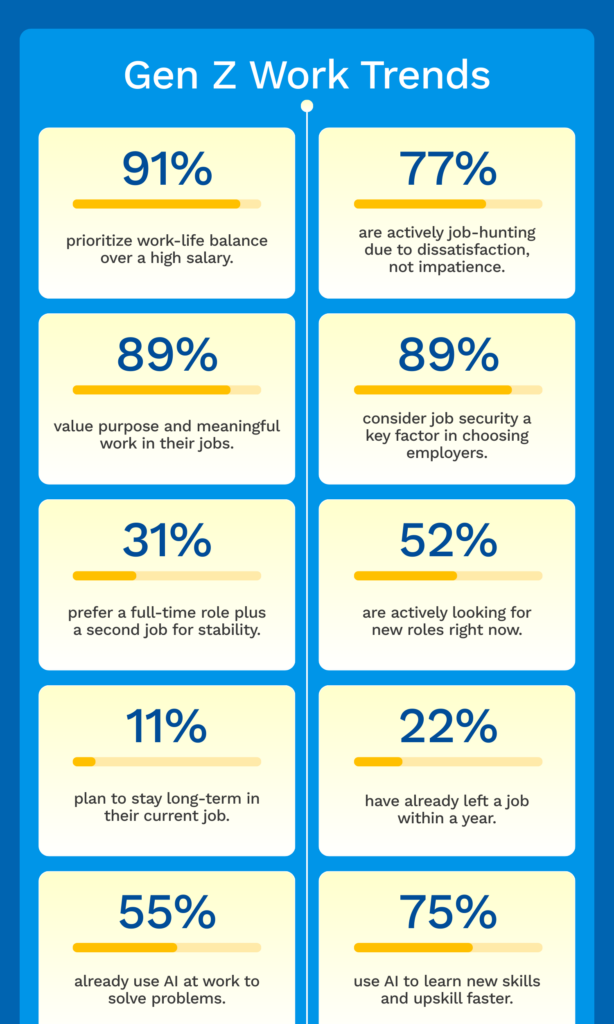
Unlike previous generations, Gen Z refuses to trade well‑being for career advancement. A McKinsey survey found that 77 % of Gen Z respondents are looking for a new job – a symptom of dissatisfaction rather than restlessness.
In another report, 91% of Gen Z workers said work‑life balance is important or very important, outpacing the 83% who said a high salary matters.
What you can do about it
Consider adding flexible work options (hybrid, flex hours, location choice) in your company policy and communicate them clearly in job descriptions.
Purpose, development and meaningful work
Money is still vital – 83 % of Gen Z professionals say a high salary is important, but it is not their only motivator.
89% of Gen Z and millennial respondents in Deloitte’s survey consider a sense of purpose important to their job satisfaction, and learning and development is one of their top reasons for choosing an employer.
Only 6% said reaching a leadership position is their primary career goal, signaling that employers should emphasize growth opportunities rather than traditional hierarchies.
What you can do about it
Discuss with your team about adding structured L&D pathways, micro-learning modules, and clear career acceleration tracks. Provide reimbursement for upskilling and certifications to fuel continuous growth.
Job security and financial well‑being
Many young workers are financially insecure. Research reveals that nearly half of Gen Z respondents (48%) do not feel financially secure and 89% of Gen Z workers view job security as important.
This anxiety fuels moonlighting culture – Randstad finds that only 45% of Gen Z talent hold traditional full‑time roles and that 31 % would prefer to pair a full‑time job with a second job. More than half (52 %) are actively looking for new roles, while only 11 % plan to stay in their current job long term.
What you can do about it
Create transparent career paths, stable contract structures, and fair compensation models that reinforce security. Offer flexibility for side projects as long as performance and outcomes stay strong, helping Gen Z meet financial goals without compromising work quality.
Mobility and growth‑hunting
Short tenures do not necessarily signal disloyalty. Randstad’s survey of more than 11,000 workers found that Gen Z’s average tenure in the first five years of their career is 1.1 years, compared with 1.8 years for Millennials and 2.8 years for Gen X.
Gen Z workers leave roles because they perceive limited growth; 41 % say they always consider their long‑term goals when making job decisions. Another 22% have already left a job within a year, nearly double the rate of Millennials.
What you can do about it
Revisit rigid “no-rehire” policies – if talent returns with stronger skills, they can add even greater value with minimal retraining. Support internal mobility, short-term sabbaticals, and boomerang hiring pathways to retain familiarity, reduce onboarding time, and keep high-potential employees within the ecosystem.
Fully digitized interview process
Gen Z is the first fully digital generation, and they expect employers to be tech‑forward. Hence, one of the most prominent Gen Z hiring trends is the demand for a fully digitized, AI-powered interview experience.
Randstad data shows that 55% of Gen Z employees already use AI at work to solve problems, 50% use AI tools in their job search and 75% use AI to upskill. This proficiency extends to job‑hunting. With Gen Z’s high comfort with technology and their preference for convenience over traditional interview fatigue, they now expect a smooth, user-friendly hiring experience.
What you can do about it
Adopt intuitive, user-friendly recruitment automation tools like, ZappyVue – automated video interviews to create a seamless experience that feels modern, efficient, and respectful of candidates’ time.
Transparent easy and engaging application process
Gen Z expects clarity and efficiency. Lengthy forms, unclear job descriptions, and slow responses are instant deal-breakers.
They want a hiring experience that is fast, transparent, mobile-friendly, and engaging, with real-time communication and clear expectations at every step.
This is leading companies to adopt AI-powered recruitment automation platforms, which not only attracts top talent, but also significantly reduces their TAT (turn over time), making it a win on all fronts.
How to attract and win Gen Z talent with a technology-first approach
These evolving Gen Z hiring trends require employers to rethink their strategies, from recruitment to retention, to stay relevant.
Shift to skills‑first recruiting
Reports suggest that employers are moving away from pedigree‑based hiring to skill-based hiring.
70% plan to hire people with new skills, while many are dropping degree requirements and embracing skills‑first approaches.
Given that entry‑level job postings have fallen and degree inflation persists, recruiters need to prioritize competencies, portfolio evidence and adaptability over formal qualifications.
Offer flexibility and meaningful work
Since 91% of Gen Z workers rank work‑life balance as important, flexible schedules, remote and hybrid options and wellness programs are essential.
Employers should articulate how roles contribute to a broader mission, as 89% of Gen Z care about purpose. Clear advancement pathways, mentorship and continuous learning (e.g., micro‑credentials, online courses) will help retain ambitious Gen Z employees who might otherwise job‑hop after 1.1 years.
Invest in AI and digital hiring tools
Because more than half of Gen Z workers already use AI to solve problems, employers should integrate technology into recruitment.
AI-powered applicant tracking systems (ATS) and recruitment automation platforms can handle high application volumes, screen candidates based on skills and behaviors and reduce bias through structured workflows.
Video interviewing software not only meets Gen Z’s digital expectations but also shortens hiring cycles, allowing interviewers to assess communication and problem‑solving skills.
Platforms like Zappyhire provide end‑to‑end automation with customization functionality to create bespoke workflows that align with each role’s requirements.
So, incorporating AI responsibly – transparently and with human oversight – will help employers build trust with Gen Z candidates.
Support mental health and financial wellness
As part of broader Gen Z hiring trends, surveys show that many Gen Z workers experience anxiety and financial stress. Deloitte’s research links positive mental well‑being to a sense of purpose at work: 67% of Gen Z with good mental health feel their job allows them to contribute meaningfully, compared with 44% of those with poor mental health.
Employers should offer mental‑health resources, counseling and employee assistance programs.
Clear pay structures, salary reviews and financial‑literacy training can also improve retention among a cohort where nearly half feel financially insecure.
Embrace diversity, inclusion and ethical leadership
Gen Z expects workplaces to be inclusive and socially responsible. While diversity statistics vary by region, many Gen Z candidates factor employers’ values into their job decisions.
Transparent communication, fair hiring practices and genuine commitment to social impact can differentiate employers in a competitive talent market.
Frequently asked questions (FAQ)
Why does Gen Z change jobs so often?
Gen Z’s average tenure during the first five years of their career is 1.1 years. They leave roles because they seek growth and feel blocked by limited progression or rigid structures.
Employers who provide clear development pathways and mentorship can surely retain Gen Z talent longer.
What do Gen Z candidates value most when choosing a job?
Work‑life balance, job security, fair pay and meaningful work top the list. Reports found that 91% prioritize work‑life balance, 89% value job security and 83% see a high salary as important. Plus, learning and development is also among their top reasons for choosing an employer
How can recruiters attract Gen Z talent?
Adopt a skills‑first hiring philosophy, offer flexible schedules, showcase purpose‑driven missions.
Being clear in communication about growth opportunities and wellness programs will also attract Gen Z candidates.
These approaches align with the latest Gen Z hiring trends shaping the current recruitment strategies.
How to hire Gen Z talent easily?
Meet them where they are – fast, digital and straightforward. Simplify your process with automation so applications move quickly, interviews are easy to schedule, and updates are timely.
Use short, structured assessments to evaluate real skills, not lengthy forms or multiple rounds.
Be upfront about culture and flexibility as Gen Z makes decisions fast when expectations are clear. A simple, mobile-friendly hiring journey will help you win them before competitors do.